
Infrastructure as Care
Is a big tunnel for stormwater the same as care? Is care infrastructure?

Last week, I rode my bike into Rock Creek Park for a groundbreaking ceremony. DC Water — the public water and sanitation utility — is going to build a big tunnel under the forest, about a half-mile long. It will cost $70 million and will take four years. There will be underground blasting and a huge mechanical tunnel borer. It might be noisy and unpleasant and nearby residents probably won’t like it. The largest apartment building in Washington DC is just above the tunnel.


While I was there, I was thinking about Deb Chachra’s idea that infrastructure is “care at scale.” And she defines infrastructure as things you don’t think about that make normal life possible. Infrastructure is often practically invisible; you only notice when it’s not there or not working right.
The Piney Branch Tunnel is an extreme example of invisible care because it won’t even provide care directly to humans; its purpose is to protect downstream water quality and the environment. When it’s done, it will keep a lot of sewer water out of Rock Creek and downstream to the Potomac River, Chesapeake Bay and ultimately the Atlantic Ocean. It will reduce the number of sewage overflows from about 25 overflows per year to roughly one, according to DC Water.
This will benefit humans, of course. Personally, I’d love to swim in Rock Creek; and the swimming hole I have in mind is downstream from Piney Branch. If I ever swim there — or if my kids or their kids ever do — we’ll have the Piney Branch tunnel to thank for keeping sewage out of the creek. But my kids and their kids probably won’t even know about it.
The Piney Branch tunnel illustrates why infrastructure disappears from public consciousness. If it succeeds, the creek will be clean and we will swim in it like residents did 100 years ago. Fifty years from now residents will probably assume sewage doesn’t overflow into Rock Creek, but not know how or why.
So much of infrastructure is invisible — or so ordinary that no one sees it. And so is the care that infrastructure offers; we benefit from clean drinking water, from flipping a switch on the wall for light, pushing a button for heating or cooling. But we barely think about it and the vast investments and systems that make possible these daily conveniences. In fact, they’re more than conveniences, they’re necessities. And without the infrastructure, providing these necessities for ourselves would be nearly impossible.
Infrastructure is like care in that it is ubiquitous, necessary, and yet taken for granted.
But infrastructure isn’t really care
Highways don’t raise children. Fiber-optic and electrical cables don’t take your grandmother to her doctors appointment. The natural gas plants and pipelines won’t serve your sick spouse a consoling bowl of chicken soup.
Infrastructure can certainly help with care, but it isn’t care by itself. Infrastructure exists whether you need care or not, whether you are a caregiver or not. Infrastructure operates at large scale, but delivering care is a much more granular, more nuanced, and more human interaction.
It is nice to think of infrastructure as motivated by care, as a contribution to care. But they’re not the same thing. And plenty of infrastructure does not help care — and sometimes even undermines it. In fact, making infrastructure more sensitive to care and more accommodating of care would be valuable. Just as we review infrastructure projects for their economic and environmental impacts, we could do a care review, to ensure that the needs and interests of people who provide care and people who need care are considered. What kind of sidewalks and crosswalks work well for baby strollers? Can you get them on buses? How to ensure disabled people can move easily and affordably through cities? By themselves or with assistance?
Although it would be conceptually complex, a care review process would be a really useful contribution to make sure infrastructure enhances and supports care relationships. Anyone want to develop that with me?
Is care infrastructure?
Maybe infrastructure isn’t care. But is care infrastructure?
In President Biden’s first year, there was a big push to pass a new infrastructure package. The result was the Infrastructure Investment and Jobs Act (IIJA), also known as the Bipartisan Infrastructure Law (BIL), signed into law on November 15, 2021. It was one of the largest federal infrastructure investments in U.S. history, providing about $1.2 trillion for bridges, highways, and other transport, for clean water and broadband internet, and for electric grids and green investments.
But President Biden and many advocates wanted to include a companion agenda of “care infrastructure” including universal pre-K, child care subsidies, paid family and medical leave, home care for older adults and people with disabilities, expanded child tax credits, housing, and more. They argued that these initiatives were as important as the physical infrastructure and would provide similar economic benefits.
Ai-jen Poo, who won a MacArthur Genius Grant and is co-founder of the National Domestic Workers Alliance, argued, “Care is infrastructure & care work makes all other work possible….Care is infrastructure, silly.”
Care advocates pushed to include “care infrastructure” first in a jobs bill, then in the infrastructure bill, and finally in a separate package, the Build Back Better bill.
As politics and rhetoric, “care is infrastructure” made sense, although it wasn’t successful and the policy package languished and never passed the Senate. But, conceptually, I was never sure it worked. Is care really infrastructure?
Care and care systems behave a bit like infrastructure: they enable other activities, including economic activities. Providing care enables people to work and the economy to grow. Child care, for example, enables women to join the paid labor force, which is very important because a lot of talent and skill is otherwise removed from the labor force. And labor supply constraints has been a key limited factor for economic growth.
Care systems provide benefits to those receiving care, but also secondary and tertiary benefits to people and sectors of the economy. Like infrastructure, care provides direct employment, but also unleashes economic and social energy which benefits society much more broadly. These are positive externalities that are not always captured in economic or social analysis.
Care systems produce services that are important to families and improve standards of living. Just like physical infrastructure delivers services like electricity and water supply. A road allows someone to get to work, child care allows them to leave the house. Broadband enables remote work, elder care enables an adult child to remain employed rather than becoming a full-time caregiver.
Care and physical infrastructure share universality. Care is universal, undertaken by every society, culture and family, across stages of life and across time. Infrastructure is usually oriented towards universality, improving access and affordability for life-improving resources and services. Most infrastructure systems are designed to subsidize access for poor or remote users.
However, care and care systems behave differently than physical infrastructure in other ways.
Typically, infrastructure requires large upfront costs — capital — to provide systems and services that sustain over time. Gathering the financing for these large costs is one of the huge challenges for infrastructure and also why it often falls to governments to organize and mobilize the resources.
Care does not usually rely on large upfront costs and financing. Care is typically not capital-intensive, but rather labor-intensive. Care is fundamentally about the relationships and human interaction which is harder to quantify and also harder to finance.
Physical infrastructure is about scale; serving thousands or millions of households with impersonalized services and access. Physical infrastructure generally consists of capital-intensive networks capable of serving large numbers of users simultaneously.
By contrast, the unit of analysis for care is usually individual, or paired: caregiver and care recipient. Scaling care is possible, but care is — and should be — personalized and highly variable. A single care provider can only provide a limited amount of care. And people who need care have no guarantees except through personal or private contractual means. Every parent takes a different tactic, every elder has specific needs, medical, emotional, social. Disabled people have a wide variety of disability and ability that is difficult to abstract and homogenize.
Physical infrastructure is meant to last years or decades, sometimes centuries. Care has a very temporal dimension. Children grow up. Sick people get better. Some sick people die. Care relationships are rarely stable more than a few years because care providers and care receivers change. Care is a constant, but only conceptually. In specific, care is heterogeneous, granular, changing.
Technology, and technological change is relevant to both physical infrastructure and to care. But the opportunity to dramatically improve efficiency and increase scale of care seems limited. Solar power is remaking energy grids. EVs are remaking auto infrastructure. But how will technology make evening bedtime routines for your kids more efficient? Why would you want to? Time itself, and physical accompaniment, are critical components of care. For most people, reducing those would mean reducing care itself, rather than making it more efficient.
When we use the term infrastructure, we usually mean something like physical infrastructure. Care is a kind of infrastructure, perhaps, but perhaps better qualified as social or human infrastructure.
Physical infrastructure: durable assets that move people, water, energy, goods, or information. Requires large upfront capital investments, and smaller ongoing maintanence costs.
Social infrastructure (or care infrastructure): systems that develop and sustain human capabilities. The largest costs are in the ongoing maintenance and operation of these systems, especially labor costs and time.
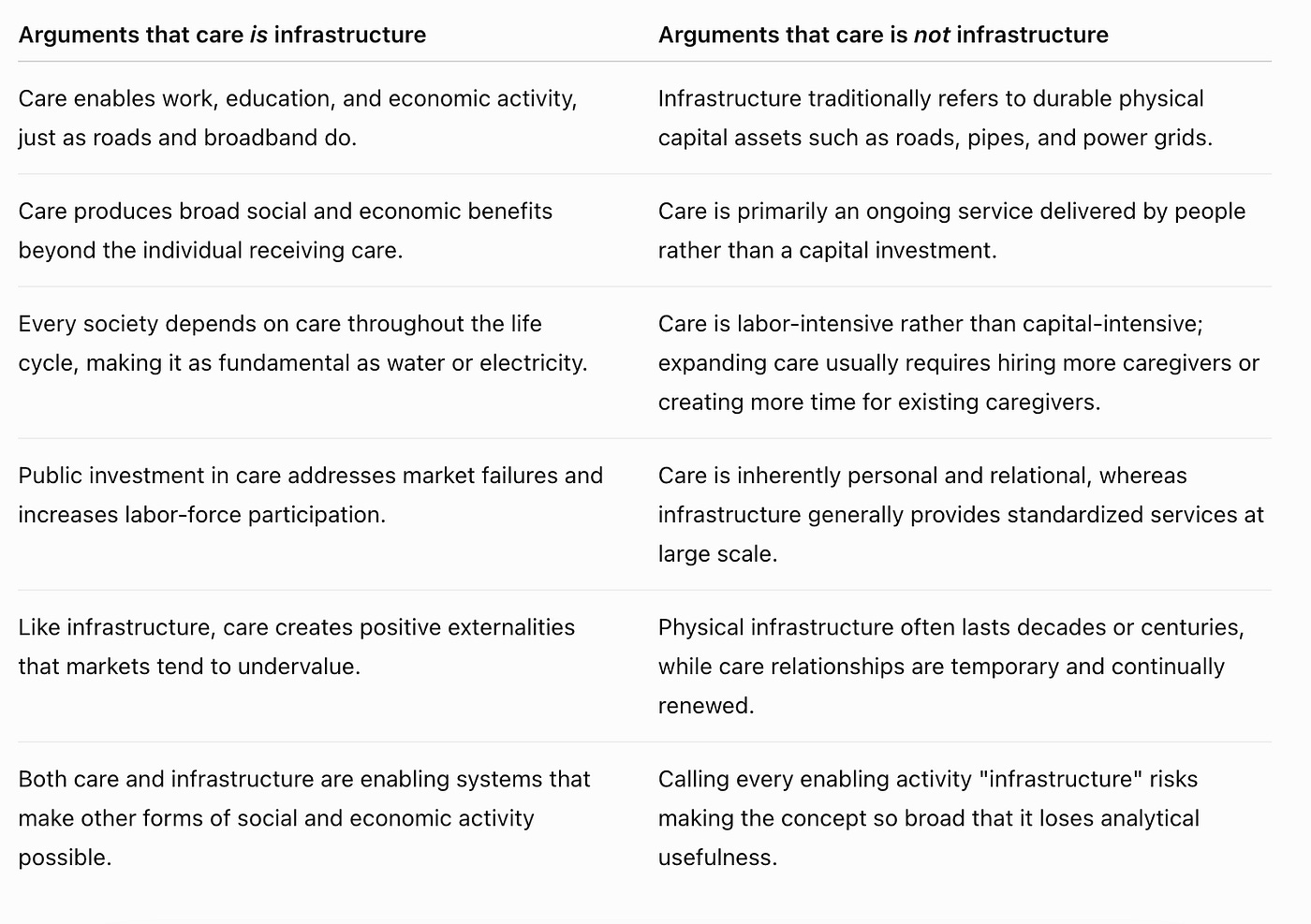
On balance, I don’t think care is infrastructure as we normally think of it. Positioning care as infrastructure also has risks: for investors and policy-makers care might not deliver the returns of other infrastructure. Projects are measured, compared, and evaluated on those returns. Care delivers returns, but also delivers other benefits which are not typically considered as part of infrastructure planning and investment. What if care is not the best infrastructure investment according to traditional analysis? Do we want care investments to compete for public and private resources on those terms?
I think care is something else. And calling care infrastructure might help politicians and economists see that it has economic benefits and serves an enabling function. This might help make care a higher political priority and secure more public resources. That would be good.
But, I don’t think saying care is infrastructure helps us see and understand care better. And, so far, it has not helped us win more public resources.
ENDS///
I hope you get to swim again! What I miss most about DC is Rock Creek Park. I spent hundreds of hours there.